 By
By 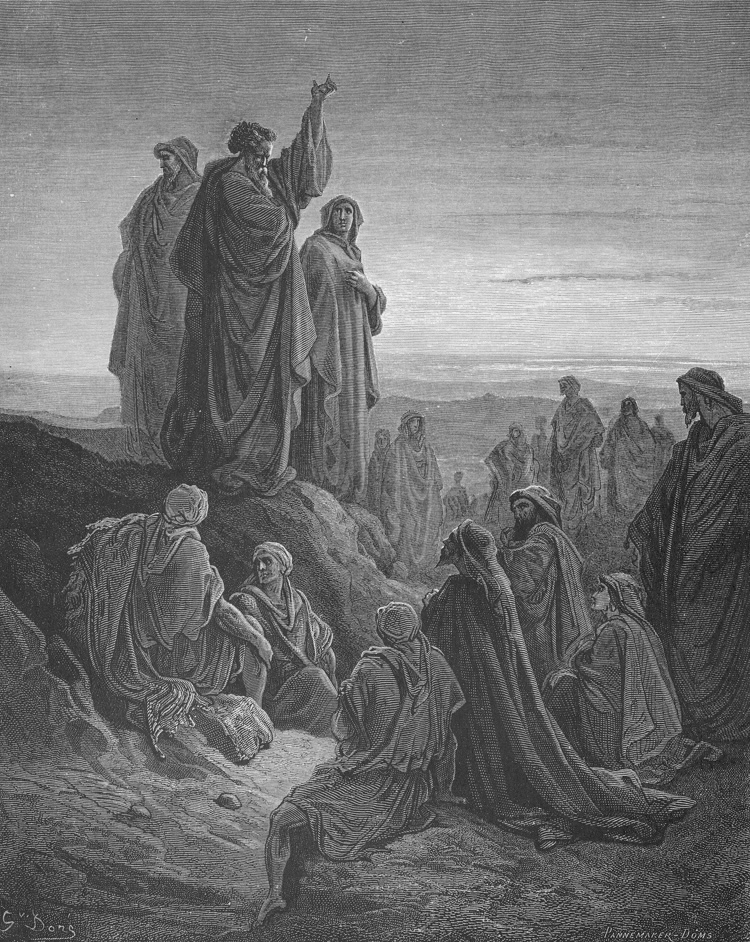
Apostles Preach the Gospel, Gustav Doré, 1866. From The Doré Bible Gallery.
A COMPARISON OF ROMAN CATHOLIC AND REFORMED VIEWS ON APOSTOLICITY
The New Testament people of God are rightly described as apostolic. The church in all times and all places following the resurrection of Christ traces its authority back to the twelve apostles of Jesus, who were chosen by him, were witnesses to his resurrection, and were endowed with the Holy Spirit at Pentecost to proclaim the gospel to the ends of the earth. However, different Christians today have different notions of what it means to be apostolic. Disagreements between the Roman Catholic (RC) and Reformed views on ecclesiology run deep, and the matter of the church’s apostolicity is close to the heart of the disagreement. This paper aims to synthesize the debate between these two views, giving special attention to the heart of the disagreement. Ultimately this paper will argue that the Reformed view on apostolicity better reflects the witness of the New Testament and the structure of the church in its first postapostolic generation.
First, the Roman Catholic view will be summarized. Second, a few problems with the Roman Catholic view will be listed. Third, the Reformed view will be summarized with its responses to the problems of the Roman Catholic view.
I. The Roman Catholic view
Before any description of or evidence for the Roman Catholic view can be presented, it is vital to first acknowledge the core presupposition which grounds RC reasoning. According to Rome, Scripture and RC tradition share the same authority. They cannot be separated and cannot be appealed to in contradiction to each other.1 Thus, all interpretation of Biblical evidence is through the lens of later church developments.
The Catholic Catechism identifies three distinguishing marks of the apostolicity of the Church: its founding upon and continuation from the ministry of the apostles, the upholding of the apostles’ teaching, and the preservation of an unbroken chain of apostolic successors.2 This last point is of special import, for while the Reformed tradition claims the first two points as well, it denies the possibility of the third.
Rome finds its primary biblical evidence for its view in Matthew 16:13-20. Upon Peter’s declaration that Jesus is the Christ, the Son of the living God, Jesus replies “Blessed are you, Simon Bar-Jonah! For flesh and blood has not revealed this to you, but my Father who is in heaven. And I tell you, you are Peter, and on this rock I will build my church, and the gates of hell shall not prevail against it. I will give you the keys of the kingdom of heaven, and whatever you bind on earth shall be bound in heaven, and whatever you loose on earth shall be loosed in heaven” (Mt 16:17–19). Rome interprets this as Jesus identifying Peter as “the rock,” the foundation of the whole church, and granting him authority above the whole church and even above all the other apostles.3 This is paired with the belief that the apostles appointed direct successors to carry their authority as bishops over the church.4 While lacking the unique blessing of witnessing the resurrection of Christ with their own eyes, all other marks of the office of apostle—including miraculous gifts—were passed on to their successors.5 It is by the college of bishops, with the pope as Peter’s successor, that the Roman Catholic Church remains apostolic. They are the ones who ensure the church remains in line with the teaching of the apostles, but they define what the apostles taught as the tradition of the church.6
Rome cites church history to confirm its view on apostolic succession. According to their interpretation, the earliest Church Fathers already recognized the establishment of the office of bishop as distinct from pastors or elders, the institution of apostolic succession, and the primacy of the bishop of Rome. They point to the writings of Ignatius of Antioch, Clement, Hippolytus, Irenaeus, and Tertullian.7 Such succession was necessary to maintain the purity of the church’s doctrine and the efficacy of its sacraments.8 This succession has continued throughout the whole history of the Roman Catholic Church without interruption or detraction; Rome considers its indefectibility a key evidence for its position as the one true Church of Jesus.
II. Problems with the Roman Catholic view
There are a host of problems with the RC understanding of its own apostolicity. To start, early church history is not as clear-cut on apostolic succession or even episcopal structure as Rome claims. Catholic and Reformed scholars alike are willing to acknowledge how scant second-century resources on the topic are, which leads to a wide range of interpretations.9 However, when following the historical progression from the New Testament to the end of the second century, episcopacy appears to be a later development and a departure from the church’s original postapostolic structure.
First, the terms used for bishop (ἐπίσκοπος) and elder (πρεσβύτερος) are interchangeable in the New Testament; Paul identifies the same group of leaders in Ephesus as both terms.10 The Didache instructs churches to elect for themselves bishops (plural) and deacons, using these terms in the same way Paul did in his letters.11 1 Clement written as early as 96 AD describes a bishop, in partnership with other churches’ bishops, reprimanding the church in Corinth for improperly deposing their leaders. Rome identifies the author of this letter as the bishop of Rome and views it as evidence of Peter’s successor practicing his God-ordained authority over other bishops, but their claim overextends. It is just as likely that this Clement was acting as a spokesperson among equals, in much the same way the author of a letter sent by a presbytery may be viewed today.12 Other examples can be drawn from Polycarp and the Shepherd of Hermas in support of a plurality of elder-bishops as retaining equal authority.13
Ignatius, writing from Antioch around 110-117 AD, writes openly about the office of a single bishop over churches, but he does not mention a bishop in Rome when he writes to the church in Rome, only bishops in five other Asian congregations.14 Additionally, Ignatius never directly depicts the bishop as having authority over the whole community of local churches and their pastors—what we might call a presbytery today.15 It is not until Irenaeus, writing at the end of the second century, that anyone claims apostolic succession and the primacy of the bishop over other elders. This was likely in response to rising heterodox belief; if he could ground his authority in an unbroken chain of bishops appointed directly by the apostles, he could more persuasively undermine the gnostics’ claims to secret knowledge passed down from the apostles.16 Thus, while episcopal polity was an early innovation in church history—as early as the second century—it still stands out as a significant departure from the earlier structure of a plurality of elders, which is more in line with the picture the New Testament gives us of the apostles’ instruction.17
The development of the papacy is an even later development and an even further departure. While the bishop in Rome was regarded with great esteem and even preeminence, this was at first on the basis of the church in Rome’s reputation and historic founding and not on a supposed reception of Peter’s keys to the kingdom.18 In fact, the strict doctrine that the pope derives his authority from the unique position of Peter as the head of all apostles was not fully codified until Vatican I.19
Whether or not Peter received such special appointment by Christ is close to heart of the debate. In general, Roman Catholic scholars assert that Jesus naming Peter and declaring “on this rock I will build my church” is the foundation of Petrine primacy. Peter alone was given the keys to the kingdom, and the other apostles execute their authority only insofar as they remain in line with Peter; so it is with bishops under the authority of the pope.20
Reformed scholars disagree, to a lesser degree with each other, but to a greater degree with Rome. While most Reformed scholars instead identify “this rock” as being Peter’s confession, Herman Bavinck still identifies Peter as “this rock” and considers him the “foremost of the apostles, the principal founder of the church, the example and leader of all the confessors of Christ through the centuries,” but further clarifies that Peter is a first among equals.21 Clowney identifies both Peter and the confession together as “this rock.”22 R.B. Kuiper argues “‘this rock’ is none other than the confessing Peter as representative of the apostles,” as they share the keys of the kingdom together.23 Clearly both the confession and the person are significant. However, the rest of the New Testament does not treat this passage as a foundation for apostolic succession of persons and office. Peter and his confession as “the rock” are a recognition that Christ established his church both through real, historical persons filling the unique role of apostles and the confession Peter makes. The church’s apostolicity is both the historical events of its founding and the doctrine, the confession, the teaching of those apostles.
What is the reason for the disagreement between Rome and the Reformed? Ultimately it comes down to the presuppositions of each. For Rome, Scripture and church tradition grow together in an inseparable interdependence and share equal authority. They believe the church grew out of the apostle’s teaching as recorded in the New Testament, but also that the bishops were the ones who decided the canon of the New Testament. Rome may present its current views on papal supremacy and apostolic succession as if they had always been held by the church and were always the logical conclusion of reading Scripture, though as shown above, Mt 16:18 was not officially interpreted in this way until the nineteenth century. Regardless of when papal supremacy becomes enshrined in Roman Catholic history, the fact that it eventually becomes enshrined is sufficient when church tradition is given equal authority to Scripture. According to the Roman Catholic Church, this is not prooftexting. Rather, this is precisely how the doctrine of the church comes about. It is a continuously evolving dialog between Scripture and the church’s tradition. The bishops of the Roman Catholic Church, led by the pope, neither submit to Scripture as their only authority nor impose meaning upon Scripture. They discover the meaning of Scripture as they encounter new situations in history and consult each other on how to respond, based on the text and their church’s history.
The Reformed tradition is not convinced. Rome claims to hold the authority of Scripture and tradition as hand-in-hand, but in reality, tradition has the upper hand. The doctrine of infallibility must rest somewhere. In Rome, it rests in the pope alone. He has authority to determine the meaning of Scripture: “And therefore his definitions, of themselves, and not from the consent of the Church, are justly styled irreformable, since they are pronounced with the assistance of the Holy Spirit, promised to him in blessed Peter, and therefore they need no approval of others, nor do they allow an appeal to any other judgment.”24
In summary, the Roman Catholic view of apostolicity suffers from at least three weaknesses. First, its interpretation of early church history is highly debatable. While the episcopate was an early ecclesiological development, it is still a development beyond the presbyterian structure instituted by the apostles, and the evidence for an unbroken chain of Peter’s successors is dubious at best. Second, its understanding of Scripture is skewed by its own tradition. Even if Jesus’s words “this rock” refer to Peter, the conclusions the RC draws from Matthew 16:18 are unwarranted and incongruent with the rest of the New Testament. Scripture does not mandate an episcopal structure. Third, its presuppositions at best result in an infinite regression—does the church’s tradition come first or the Word?—and in reality result in a fully top-down authority structure, resting infallibility in the pope alone, thus undermining its own authority.
III. The Reformed view
The Reformed view of the church’s apostolicity avoids each of the pitfalls Rome faces. Though already addressed in part, the evidence will be further explored here along with a more robust systematic explanation of Reformed ecclesiology.
Unlike Roman Catholic theology, Reformed theology places infallibility in the inerrant, inspired word of God.25 Against the Word of God alone are all traditions and teachings judged, and the church wields divine truth and authority only insofar as it remains in line with Scripture.26 The authority of Scripture comes from its divine authorship—it is authoritative because it is the word of God, not merely of man. This includes the New Testament, largely written by apostles or those directly under the authority and tutelage of the apostles. Here Rome and the Reformed tradition agree: the writings of New Testament authors are considered authoritative Scripture because they were written by the inspiration of the Holy Spirit.27 However, they differ in that Rome believes the same authority rests in the pope today; his judgments are equal canon to Scripture because he continues to fill the same chair as the apostle Peter and is endowed with the same Spiritual authority.
The Reformed view rejects this. The New Testament authors testify to the unique, once-and-for-all authority of the apostles and the completion of the canon. John closes his Revelation with a strong warning against adding or removing any words from his account (Rv 22:17-19). Paul declares that any who teach a gospel contrary to the one he teaches is accursed (Gal 1:9). Peter warns his readers of those who would twist Paul’s words, placing them on equal authority with his own and the rest of Scripture (2 Pet 3:16). This authoritative word is directly tied to their position as apostles, participants in Christ’s earthly ministry and witnesses to his resurrection (2 Pet 1:21, 1 Jn 1:1-3). The later codification of the New Testament canon was not the church granting authority to these texts, it was the church recognizing the Holy Spirit-inspired authority they already had.28
Church officers today no longer carry the same authority because they do not fill the same office. In the pastoral epistles, Paul charges Timothy and Titus with guarding the deposit of apostolic teaching (2 Tim 1:13-14), instructing their churches that which accords with godliness and teaching the sound doctrine they received (1 Tim 4:6, Tit 2:1), and silencing those who teach anything contrary to the apostolic message (1 Tim 1:3-5, Tit 1:10-11). While Timothy and Titus are given the unique authority to appoint elders, they do so as those who occupy their own extraordinary office of evangelists.29 Those offices cease at the end of the first century.30 Once the apostles and evangelists laid the foundation for the church across the Roman world, the apostles gave guidance for the continuation of church governance.
That government consisted in elders and deacons. As listed above, the office of elder was not distinguished from bishops. This one office carried the responsibility to shepherd and teach their local community of believers. Some devoted all their time to the role and were compensated for their work (1 Tim 5:17-18). During the apostolic age, those in extraordinary offices had the authority to appoint elders themselves; however, it is clear that the office of elder was to continue even after the passing of the extraordinary offices. Hence why Paul commands Timothy to entrust the apostolic teaching to faithful men who will be able to teach others (2 Tim 2:2).
Rather than appointing single bishops as their successors who would carry authority over all other offices, the apostles laid the foundation for all elders to share authority. Paul and Barnabas appoint elders (plural) in all the churches they planted (Ac 14:23) and instructs Titus to do the same (Tit 1:5). In fact, the apostles went out of their way to emphasize the equality and plurality of leadership, especially toward the end of their ministry. Paul, identifying as an old man (Phm 9), and Timothy appeal to Philemon as “our fellow worker” (συνεργῷ ἡμῶν, Phm 1); Paul identifies himself as Philemon’s “partner” (κοινωνόν, Phm 17) and rather than commanding him with apostolic authority prefers to “do nothing without [his] consent in order that [his] godliness might not be by compulsion but of [his] own accord” (Phm 14). Peter charges the elders among churches to shepherd the flock, identifying himself as a “fellow shepherd,” (συμπρεσβύτερος), indicating that the oversight of the church is a shared endeavor (1 Pet 5:1-4).
The Johannine epistles are perhaps the most instructive picture of what it means for the church to be apostolic in a postapostolic age. These three letters give a snapshot of the sun setting on the apostolic age as John, the last living apostle, instructs the church on key doctrines, church leadership, and mission.31 John grounds the authority of his message in his apostolic witness (1 Jn 1:1-3). It was written to encourage believers to remain committed to the teaching of the apostles, which is synonymous with the teachings of Christ. Much of the content and themes in 1 John come from Jesus’ teaching in John 13-17.32 The specific teachings 1 John addresses are the divinity of Christ as equal with the Father, the historical incarnation, the forgiveness of sins, the importance of repentance, and the Christian ethic summarized in the command to love—especially when it comes to maintaining unity in the church. That unity had been strained by some falling away from the church following the false teachings of “antichrists.” John warns them not to associate with those who reject apostolic teaching.
The shorter letters of 2-3 John give even more concrete snapshots of the New Testament’s apostolicity. Similar to Peter identifying himself as a “fellow shepherd,” it is significant John identifies himself simply as “the elder.” Yarbrough writes:
John remained primary (because he was an apostle) among equals (because he too was a sinner and a servant of the gospel). This may help explain why he styled himself “elder” in 2-3 John, not insisting on the honorific “apostle” or “original disciple” that were his historical and ecclesial due (cf. Bauckham 2006: 172 on Peter’s reserved personal reminiscences).33
In doing so, the apostle models the equality of presbyters in the postapostolic age. In 2 John, the apostle warns against deceivers who deny Christ’s incarnation (2 Jn 7). In order to remain in the loving fellowship of God and the church, John instructs them to not “advance” (προάγων) beyond the “teaching of Christ” (2 Jn 9). He instructs that if any come with a teaching different than his own apostolic teaching on Jesus, they are to be denied fellowship (2 Jn 10). Thus, teachers are to be measured by their adherence to apostolic teaching.
In 3 John, John instructs the church leader Gaius to reprimand Diotrephes for not accepting “our authority” (3 Jn 9). This first-person plural could be an “editorial plural meaning John” specifically or refer to John and Gaius together, or possibly even to the collective apostolate.34 Either way, Diotrephes has found himself out of line with apostolic teaching. He may not hold heretical doctrine, but at the very least he defies the teaching Christ gave the apostles, “Whoever wishes to be first among you, that person is to be your servant” (Mt 20:27), and he refuses to cooperate with other church leaders.35 John, calling himself an elder, intends on rebuking Diotrephes as a fellow member of the community of church leaders. Gaius, on the other hand, is praised for his cooperation and support of his brothers in ministry (3 Jn 5-6).
In short, the Johannine epistles exhibit an ecclesial structure based on a plurality of leaders holding each other accountable, judged against apostolic teaching. First and 2 John emphasize doctrine as the mark of an apostolic church, while 2-3 John also display an aspect of an apostolicity often neglected in Reformed ecclesiology: mission. The Roman Catholic catechism makes an explicit connection to missions as a core component and consequence of apostolicity.36 While Reformed scholarship has a robust and growing missiology, the connection is not often made with respect to apostolicity.37 However, given the Great Commission (Mt 28:18-20, Ac 1:8), this is an aspect that cannot be ignored. John places his praise of missionary work and support right alongside his exhortation to remain within the bounds of apostolic doctrine. The Reformed tradition would do well to continue exploring the connection between apostolicity and mission.38
How, then, does the Reformed tradition view biblical apostolicity? Following the witness of Scripture and the evidence of the church in its earliest years after the apostolic age, Reformed ecclesiology holds to a presbyterian structure of government. Rather than grounding the apostolicity of the church in an unbroken chain of papal succession dating back to Peter, the Reformed tradition roots the apostolicity of the church in the teaching of the apostles as preserved in the New Testament canon. The apostles and evangelists placed the church on a trajectory to have local church communities choose their own leaders based on good character and their ability to teach.39 They placed the responsibility of holding overseers accountable to apostolic doctrine in the hands of fellow overseers. It did not matter if one was an overseer of a prominent church like Corinth, or if one was appointed by an apostle like Peter or Paul; that did not grant special status (1 Cor 1:10-17) nor did it guarantee a person would remain faithful to apostolic teaching (2 Tim 1:15; 2:17-18; 4:10). Even the apostles were capable of falling out of line with their own teaching. Peter was far from infallible, both before and after the resurrection of Christ (Mk 14:66-72, Gal 2:11-14).
IV. Conclusion
The Reformed tradition rightly notes that the only head of the church is Christ.40 He is the sole mediator between God and man; the apostles were never mediators, nor would any theoretical successors to the apostles be mediators.41 Because Christ has poured out the Holy Spirit on all believers, the whole invisible church has been made a holy priesthood and is commissioned by Christ to extend his own ministry to the whole world. Christ established the foundation of his church through the definitive work of the apostles, who then set up a structure of overseers who would steward the apostolic foundation. Apostolicity, then, is defined by our faithfulness to the apostolic doctrine, structure, and mission. The paramount mark of the apostolic church is faithful adherence to apostolic doctrine and the Word of God.42
Rome’s papal structure is a departure from the New Testament vision for apostolicity—not a top-down genealogy of “places and persons” but a bottom-up call of a local community and horizontal recognition of the presbytery that this candidate for gospel ministry is in line with the doctrine of the apostles.43 Commenting on the change to episcopal structure, Bavinck writes:
In this development, we in principle witness a reversal of the entire earlier relationship. In the apostolic era there first were church communities, assemblies of believers, in which apostles appointed overseers (episcopi) and deacons (diaconi), who were chosen with the consent of these communities and subject to their judgment. But now this order is reversed; the true church, doctrine, baptism, Eucharist, and communion with God are where the bishop is—as Ignatius keeps saying and Irenaeus and Cyprian (et al.) work out after him.44
Thus, the Reformed tradition affirms the cessation of the office of apostle and establishment of the overseer as the inheritor of the mission, not a separate bishop or pope to inherit the authority of the apostles.
Footnotes
1 “This, then, is the methodological starting point of the document: any attempt to reconstitute the past by selecting isolated phrases from the New Testament Tradition and separating them from the way they were received in the living Tradition of the Church is contradictory.” From “Catholic Teaching on Apostolic Succession.” International Theological Commission. Vatican Website. 1973. https://www.vatican.va/roman_curia/congregations/cfaith/cti_documents/rc_cti_1973_successione-apostolica_en.html
2 Catechism of the Catholic Church, 2nd ed. (Vatican City: Vatican Press, 1997), 857, https://www.scborromeo2.org/catechism-of-the-catholic-church.
3 “For our Lord placed Simon alone as the rock and the bearer of the keys of the Church, and made him shepherd of the whole flock.” From Paul VI. Lumen Gentium. Dogmatic Constitution on the Church. Vatican website. November 21, 1964. 22-23. https://www.vatican.va/archive/hist_councils/ii_vatican_council/documents/vat-ii_const_19641121_lumen-gentium_en.html
4 LG 20, Catechism of the Catholic Church 861.
5 Bellarmine lists “The glory of its miracles” as one of fifteen marks of Rome as the true church. Herman Bavinck, Reformed Dogmatics: Volume 4: Holy Spirit, Church, and New Creation (Grand Rapids, MI: Baker Academic, 2008), 307.
6 “Catholic Teaching on Apostolic Succession”, II. THE ORIGINALITY OF THE APOSTOLIC FOUNDATION OF THE CHURCH
7 “Catholic Teaching on Apostolic Succession”, III. THE APOSTLES AND APOSTOLIC SUCCESSION IN HISTORY. Bavinck, RD, 3:357.
8 LG 25-26.
9 “The absence of documents makes it difficult to say precisely how these transitions came about.” “Catholic Teaching on Apostolic Succession”, III. THE APOSTLES AND APOSTOLIC SUCCESSION IN HISTORY. “ Our second-century resources on this subject are quite thin and offer only limited and partial glimpses into ecclesiological matters.” Michael J. Kruger, Christianity at the Crossroads: How the Second Century Shaped the Future of the Church: (Downers Grove, IL: IVP Academic, 2018), 75.
10 Kruger, Christianity at the Crossroads, 76. Ac 20:28.
11 Kruger, Christianity at the Crossroads, 76-77.
12 Kruger, Christianity at the Crossroads, 78.
13 Bavinck, RD, 4:348-349.
14 Kruger, Christianity at the Crossroads, 81.
15 Kruger, Christianity at the Crossroads, 82.
16 Kruger, Christianity at the Crossroads, 83
17 Bavinck, RD, 4:358.
18 Bavinck, RD, 4:354.
19 Bavinck, RD, 4:357.
20 LG 25.
21 Bavinck, RD, 4:340.
22 Edmund Clowney, The Church. Contours of Christian Theology. (Downers Grove, IL: InterVarsity Press, 1995), 40.
23 R.B. Kuiper, The Glorious Body of Christ. (Carlisle, PA: Banner of Truth Trust, 1967), 68.
24 LG 25.
25 Westminster Confession of Faith 1.4.
26 WCF 1.10.
27 Catholic Catechism 105-114, WCF 1.5.
28 Clowney, The Church, 75.
29 Bavinck, RD, 4:340.
30 Clowney, The Church, 77.
31 This assumes John the Elder is the same person as John the Apostle, the son of Zebedee. While modern scholarship tends to disagree (Georg Strecker, The Johannine Epistles, Hermeneia (Minneapolis, MN: Fortress Press, 1996), xxxv-xlii), the historic position of the church attributes the Johannine epistle to the apostle. Many recent scholars have argued for the historic position with compelling evidence. Robert W. Yarbrough, 1-3 John. Baker Exegetical Commentary on the New Testament (Grand Rapids, MI: Baker Academic, 2008), 5-15. Charles E. Hill, “1-3 John,” in A Biblical-Theological Introduction to the New Testament (Wheaton, IL: Crossway, 2016), 486-487.
32 Stephen S. Smalley, 1,2,3 John. WBC (Waco, TX: Word Books, 1984), xxix-xxx.
33 Yarbrough, 1-3 John, 26-27.
34 Yarbrough, 1-3 John, 378.
35 Yarbrough, 1-3 John, 377.
36 Catholic Catechism, 858-860.
37 Kandiah, Krish. “An Explosion of Joy: What It Means to Be the Apostolic Church.” Christianity Today 58, no. 5 (June 2014): 46–49. https://search-ebscohost-com.rts.idm.oclc.org/login.aspx?direct=true&db=lsdar&AN=ATLA0001984809&site=ehost-live.
38 Reformed scholarship has under-treated the significant relationship between apostolicity and mission. Very few of the works researched drew any connection at all. This is not to say the Reformed tradition has no care for missions, only that it has not connected the two. The work of John Flett is an important contribution to this conversation. John G. Flett, Apostolicity: The Ecumenical Question in World Christian Perspective (Downers Grove, IL: IVP Academic, 2016).
39 Guy P. Waters, How Jesus Runs the Church (Philipsburg, NJ: P&R Publishing, 2011), 61-62.
40 WCF 8.1; 25.1,6
41 WCF 8.2; 21.2
42 Bavinck, RD, 4:324
43 In light of 2 Timothy 2, which commends the “handing on” of apostolic teaching by those called to the office of elder, there is a kind of “apostolic succession” to which the Reformed tradition can subscribe. Paul in the pastoral epistles and John in his epistles are both concerned with preparing the next generation of elders to defend the faith once delivered to them. In the same way, it is the responsibility of elders to raise up faithful men called to the ministry, training them in the skills and doctrine required for their office.
44 Bavinck, RD, 4:350.
BIBLIOGRAPHY
Bavinck, Herman, and John Bolt. Reformed Dogmatics: Volume 4: Holy Spirit, Church, and New Creation. Grand Rapids, MI: Baker Academic, 2006.
“Catholic Teaching on Apostolic Succession.” International Theological Commission. Vatican Website. 1973. https://www.vatican.va/roman_curia/congregations/cfaith/cti_documents/rc_cti_1973_successione-apostolica_en.html
Catechism of the Catholic Church, 2nd ed. (Vatican City: Vatican Press, 1997), 857, https://www.scborromeo2.org/catechism-of-the-catholic-church.
Clowney, Edmund. The Church. Contours of Christian Theology. Downers Grove, IL: InterVarsity Press, 1995.
Flett, John G. Apostolicity: The Ecumenical Question in World Christian Perspective. Downers Grove, IL: IVP Academic, 2016.
Hill, Charles E. “1-3 John,” in A Biblical-Theological Introduction to the New Testament. Wheaton, IL: Crossway, 2016.
Kandiah, Krish. “An Explosion of Joy: What It Means to Be the Apostolic Church.” Christianity Today 58, no. 5 (June 2014): 46–49. https://search-ebscohost-com.rts.idm.oclc.org/login.aspx?direct=true&db=lsdar&AN=ATLA0001984809&site=ehost-live.
Kruger, Michael J. Christianity at the Crossroads: How the Second Century Shaped the Future of the Church. Downers Grove, IL: IVP Academic, 2018.
Kuiper, R.B. The Glorious Body of Christ. Carlisle, PA: Banner of Truth Trust, 1967.
Paul VI. Lumen Gentium. Dogmatic Constitution on the Church. Vatican website. November 21, 1964. 22-23. https://www.vatican.va/archive/hist_councils/ii_vatican_council/documents/vat-ii_const_19641121_lumen-gentium_en.html
Smalley, Stephen S. 1,2,3 John. WBC. Waco, TX: Word Books, 1984.
Strecker, Georg. The Johannine Epistles, Hermeneia. Minneapolis, MN: Fortress Press, 1996.
Waters, Guy P. How Jesus Runs the Church (Philipsburg, NJ: P&R Publishing, 2011).
Yarbrough, Robert W. 1-3 John. Baker Exegetical Commentary on the New Testament. Grand Rapids, MI: Baker Academic, 2008.



 Take Note Of This