By
By 
THE ANCIENT LANDMARKS FOR A MODERN CONTEXT:
DEUTERONOMY 19:14 IN LIGHT OF CHRIST
Mosaic law places heavy emphasis on the land portions distributed to all the families of Israel according to their tribe. Among the various laws dictating how Israel is to handle land tenure, Deuteronomy 19:14 commands Israel to not move the landmarks which the first generation to take the land of Canaan would place. This law is unique both in its immediate literary context and in the broader collection of Mosaic law. An exploration of the significance of the land in the Pentateuch will shine light on this law, the way Christ fulfills it, and the bearing it has on the church today. This paper aims to show that Deuteronomy 19:14 simultaneously gives Christians confidence in their imperishable inheritance and guidance in how to approach property ownership this side of heaven.
Israel and the Land
Few themes are as core to the Pentateuch as that of the land.1 From the first pages of Genesis which recount God’s work in creation to the deliverance of Noah to the promise made to Abraham all the way through the exodus and the final pages of Deuteronomy as the people prepare themselves to take Canaan, God continually draws attention to the land he has prepared for his people. A brief survey of the significance of the land through the Pentateuch will help clarify the meaning and importance of Deuteronomy 19:14.
The creation account given in Genesis 1-2 was a powerful polemic against alternative worldviews Israel would have known from its neighbors. Rather than depicting a cosmic battle in which one of a few gods form the physical world out of the bodies of their slain enemies, Moses portrays the creation of the world like the construction of a temple.2 The final act of creation is making man in his own image (Gen 1:27). God then places Adam in the garden of Eden which the Lord planted. It is described as a paradise for humanity, with every tree that is pleasant to the sight and good for food (Gen 2:9). Even greater than the creaturely pleasures in the garden is direct fellowship with the Creator. God and humanity live together in harmony. God commands humanity to be fruitful and multiply and to subdue the earth; as his image-bearers in creation they are to mirror his work of bringing chaos into order, expanding the beauty of Eden and increasing the number of image-bearers.
These various elements of the first two chapters in Genesis establish Israel’s understanding of the relationship between God, themselves, and the land. The first key principle is that the land is God’s possession. Indeed, all creation is God’s possession—Adam himself was formed from the dust of the ground. God’s primary ownership of the land will dictate how Israel is to live in and use the land. Second, Israel is to understand their work in the land along the lines of the creation mandate. Their goal is not personal security or wealth, their goal is the glory of God and the spreading of his created order.
As soon as Genesis 3, humanity abandons God’s vision. This has immediate consequences for humanity’s relationship with the land. First, God tells Adam that the ground itself is cursed because of his sin. His work will be difficult, the fruitfulness of his labor will be frustrated. This establishes the contentious relationship between the land and sinful people—the land itself will resist the sin of its inhabitants. Second, Adam and Eve are exiled from the garden of Eden. They have separated themselves from God both spiritually and geographically. Yet, in the aftermath of the fall a promise remains. God will redeem his people.
This promise grows throughout the book of Genesis. The account of Noah reiterates many of these themes. Because of the sinfulness of humanity, God pulls back his created order to let the waters overtake the land and wash it clean. Noah and his family are delivered through it and reestablished on the land. God then gives Noah new promises and new laws. God promises to never again bring cataclysm over the whole earth and restart humanity again. He commands Noah to again be fruitful and multiply as humanity ought. However, he gives further direction for how they must live in the land. Humans must respect the sanctity of life, both when it comes to eating animals and interacting with fellow humans. The relationship between remaining in the land and obeying the laws of God continues and crescendoes throughout the Pentateuch.
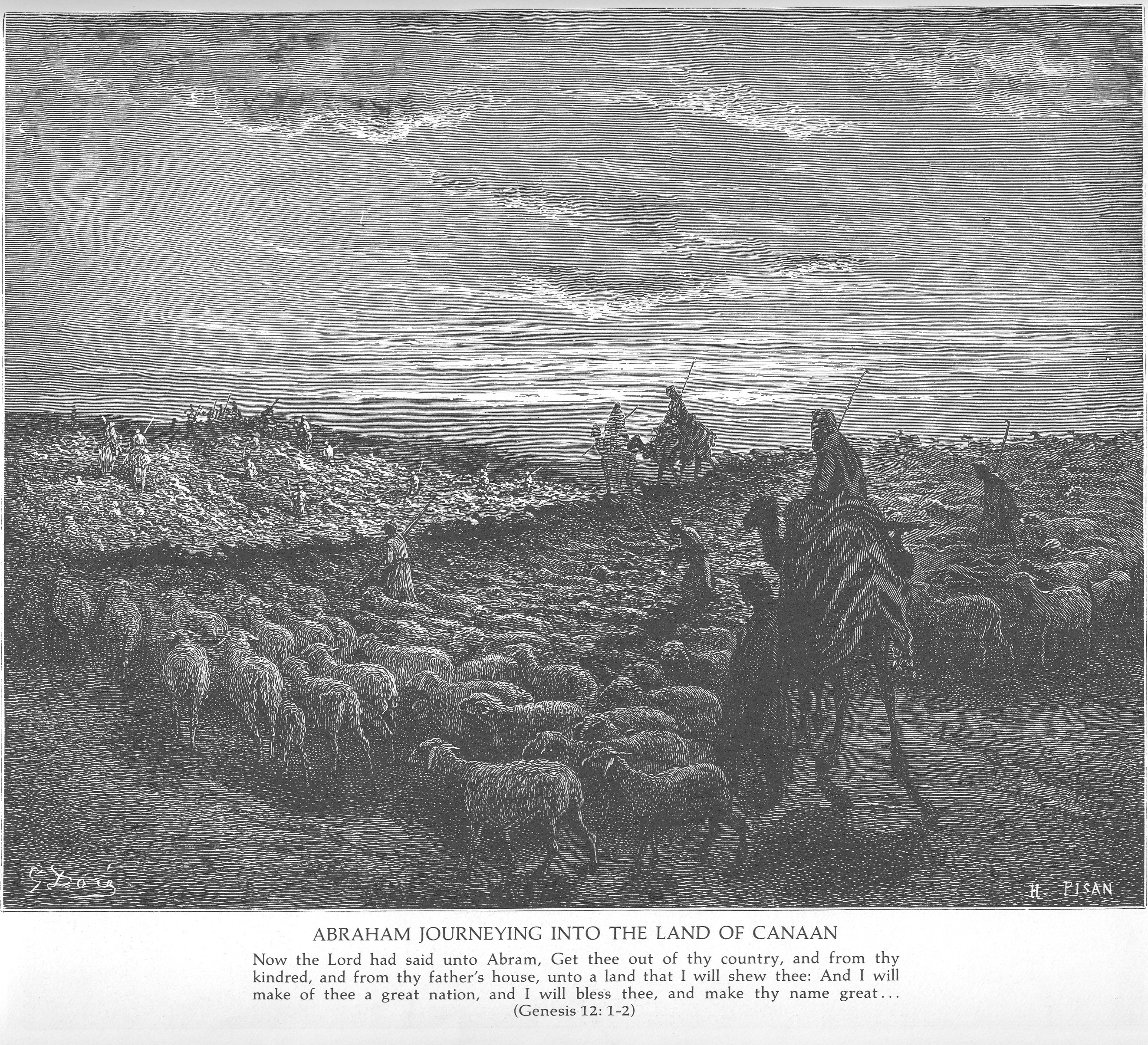
Genesis 12 introduces the most clear and central promise regarding God, Israel, and the land. God promises Abram that he will give him and his offspring a land where his descendants, who will be so fruitful they will multiply beyond the number of stars in the sky, will dwell and bless the whole world. In Genesis 15, God enters into a covenant with Abram to seal his promises. Yet this covenant includes a prophecy that his descendants will be enslaved for four hundred years in Egypt before they are brought back into the land. The reason God gives for this is crucial: “the iniquity of the Amorites is not yet complete” (Gen 15:16). Just like in Noah’s time, the sinfulness of humanity is what warrants their dispossession of the land. As Moses writes Genesis to the Israelites preparing to fulfill this prophecy it stands as a warning to them as well. If they do not obey God and instead mirror the sins of the Canaanites, they too will be driven from the land.
Laws about the Land
Many of the laws Moses records deal with Israel’s relationship to the land.3 First and most fundamentally is definition of Israel’s borders. Numbers 33:50-34:29 defines Israel’s borders and which tribes shall inhabit the land beyond the Jordan, not including Reuben, Gad, and half of Manasseh who claimed their portion east of the Jordan River. God commands Israel to drive out all the inhabitants of the land so as to not be corrupted by them, then identifies the chiefs of the tribes who will be responsible for dividing the inheritance. God makes it clear that the inheritance for each tribe is to be proportional to the size of the tribe.
Though the tribe of Levi is not given a portion like the other tribes, the Levites are assigned 48 cities across the promised land, receiving land from each of the tribes proportional to their size. Six of these cities are to be places of refuge for those guilty of manslaughter. God makes explicit the relationship between the spilling of human blood and the defiling of the land in Num 35:33-34 “You shall not pollute the land in which you live, for blood pollutes the land, and no atonement can be made for the land for the blood that is shed in it, except by the blood of the one who shed it. You shall not defile the land in which you live, in the midst of which I dwell, for I the Lord dwell in the midst of the people of Israel.”
After explaining the role and function of cities of refuge, the book of Numbers again returns to the significance of possessing the land inheritance through a story about the daughters of Zelophehad. These five daughters approached Moses, Eleazar, and the elders of Israel in Numbers 27 to plead the case of their deceased father who died with no sons to be his heirs. In their situation, their father’s line would pass away and his inheritance would go to his brothers’ families. God tells Moses the daughters are right to bring this concern before him and affirms that the daughters can inherit the land of their father. A further concern comes up later in Numbers 36. If the daughters were to marry men from outside the tribe of their ancestry, the land which they inherited from their father would then be possessed by other tribes, diminishing the inheritance given to their ancestors. God affirms the elders who bring this concern and adds the further clarification that daughters in such position ought to marry men from their own clan so as to preserve the inheritance.
Mosaic law addresses a number of other situations which might disrupt the possession of the land according to one’s inheritance. Leviticus 25 goes into detail about what God calls the year of jubilee. This is to occur every fifty years, after seven Sabbath years in which the land receives rest. During the year of jubilee, all land sales made in the past fifty years would be refunded and the land returned to its inheritors according to their tribe and clan. Israelites were to return home and again receive the inheritance God had promised to their ancestors. God gives further clarification on how these land exchanges and repayments are to be done. They are to be proportional to the amount of time ownership had been transferred, to the productivity of the land, and to the size of the plot. This applies to rural or urban land.
Though all the specifics, God makes it clear: “The land shall not be sold in perpetuity, for the land is mine. For you are strangers and sojourners with me. And in all the country you possess, you shall allow a redemption of the land” (Lev 25:23–24). Like the laws concerning the daughters of Zelophehad, the year of jubilee was designed to prevent the perpetual dispossession of families and tribes. The regular cycles of rest and reset ensured that no individual or family would permanently lose their share of the promised land. It is in this context that Deuteronomy 19:14 can be properly understood.
Moving the Ancient Landmarks
Deuteronomy 19:14 sits between two longer passages which discuss laws concerning the taking of human life. While these sections give lots of details and hypotheticals, Deuteronomy 19:14 is a plain, normative forbiddance. The words and concepts of inheritance and possession are repeated throughout this verse.
לֹ֤א תַסִּיג֙ גְּב֣וּל רֵֽעֲךָ֔ אֲשֶׁ֥ר גָּבְל֖וּ רִאשֹׁנִ֑ים בְּנַחֲלָֽתְךָ֙ אֲשֶׁ֣ר תִּנְחַ֔ל בָּאָ֕רֶץ אֲשֶׁר֙ יְהוָ֣ה אֱלֹהֶ֔יךָ נֹתֵ֥ן לְךָ֖ לְרִשְׁתָּֽהּ4
You shall not displace the boundary marker of your neighbor which the first [tribal chiefs] set as borders in your inheritance that you will take possession of, in the land which YHWH your God is giving to you to inherit.5
The verb “displace” is the Hiphil from the root סוּג. As a Hiphil it most commonly refers to the moving of boundary stones (Dt 27:17, Jb 24:2, Hos 5:10, Pr 22:28, 23:10). However, the Qal form of this root often indicates faithless backsliding or turning away from the Lord (Zeph 1:6, Isa 59:13). This fits with the close relationship between the way God’s people live in the land and their relationship with himself—to violate one’s neighbor is to turn one’s back on God.6
Rather than using the same word from Numbers 34:18 for the tribal chiefs (נָשִׂיא) here God draws special attention to the fact that they are the first generation to enter the land and receive the promised inheritance given to them by God.7 That first generation has the unique responsibility to divide the land, and what they establish will become a permanent inheritance for their descendants, just as Numbers 34 directed.
How this verse relates to the surrounding passages is debated among scholars. Many identify this law as a part of the exposition on the sixth commandment.8 Edward Woods suggests the following close connection between stealing someone’s land and taking someone’s life:
Boundary violation was recognized as by far the most frequent cause of disputes, whether between individuals or between nations, and thus a major cause of war and murder. To respect this law may have been understood here as both a realistic and symbolic statement about the reality and prevention of homicide. The clandestine removing of a neighbour’s boundary stone could be viewed as the equivalent of lying in wait for him, and taking his livelihood and ability to survive, patterned by the situation in verses 11–13, as well as false accusation (vv. 15–21) as a means of eliminating someone.9
Woods also notes the repeating pattern of apodictic prohibitions as conclusions to expositions on commandments throughout Deuteronomy “similar to 14:21 (the goat boiled in its mother’s milk) at the conclusion of the third commandment, and 25:4 (the muzzled ox treading out grain) at the conclusion of the ninth commandment.” Thus, while Deuteronomy 19:14 is a crucial law in its own right, it is also a summary law which encapsulates an essential aspect of God’s ethical standards for the covenant community. As Stephen Cook writes, “To keep boundary markers in place is Deuteronomy’s code language for protecting and building up community.”10
In summary, the prohibition of moving ancient boundary markers was a key component of maintaining the promise God made to Abraham and his offspring. It was grounded on the principle that the Israelites were not the true “owners” of the land, God was. The land was given to the children of Israel as a gift. They had not earned it, and like the Amorites before them, if their wickedness grew too foul in the eyes of the Lord the land would vomit them as well. They were to fulfill God’s vision for humanity by the way they dwelt in the land—being fruitful and multiplying, giving the land rest according to the Sabbath and jubilee years just as they rested on the sabbath, proclaiming the glory of the Lord by bearing his image.
One aspect of this included respecting the property lines first drawn up by Joshua’s generation. It was an act of faith to trust the portion God had given his people would be sufficient for their needs. While other nations would go to war with each other to seize land and grow in wealth, Israel was called to be different. By doing so with righteous obedience to all the commandments he had given them, the people of Israel would enjoy fellowship with God in their midst, first with the tabernacle and later with the temple in Jerusalem.
Christ as Our Inheritance
Space does not permit a comprehensive biblical theology of the land from Joshua to the coming of Christ. Such studies have been done and are of great benefit. For the purposes of this paper, it is sufficient to say that Israel failed to obey the Lord’s law and faced the penalty: they were driven from the promised land. During exile, the land received the rest it had missed out on for the centuries of misuse and exploitation under unfaithful generations. Many scholars agree it is likely Israel never once practiced a proper Sabbath year or Jubilee.11 Even upon their return to the land, God’s people did not experience the full blessings promised by the prophets; they anticipated a future day of the Lord in which the land will be perennially fruitful (Ezek 47:12) and the people will dwell in it securely forever (Ezek 34:26-27). Furthermore, the edenic order of the promised land will expand beyond just the borders of Israel; all the nations of the world will be blessed.
All these promises found their climactic and surprising fulfillment in the person and work of Jesus Christ. The advent of Christ brought dramatic changes to the way the people of God related with their Creator. First and foremost, dwelling with God is no longer contingent upon the land. The Gospel of John explains this in a number of ways. John 1 states that Jesus, “the word became flesh and dwelt among us” (Jn 1:14). The verb “dwelt” comes from the Greek word σκηνόω, which according to its use in the LXX literally means “to tabernacle.”12 Later, after Jesus drove out money-changers from the temple and the pharisees asked him by what authority he did this, Jesus responded “Destroy this temple and in three days I will raise it up” (Jn 2:16). The pharisees thought Jesus was insane but only because they did not understand that, as John states, “he was speaking about the temple of his body.” (Jn 2:21).
As a final example, when asked by the Samaritan woman on which mountain God was to be worshipped, Jesus answered her “Woman, believe me, the hour is coming when neither on this mountain nor in Jerusalem will you worship the Father. You worship what you do not know; we worship what we know, for salvation is from the Jews. But the hour is coming, and is now here, when the true worshipers will worship the Father in spirit and truth, for the Father is seeking such people to worship him.” (Jn 4:21–23). All this shows that the former promises which were tied to the land are now fulfilled in and received by the person Jesus.
Consider the situation this way. In the garden of Eden, humanity enjoyed both spiritual and geographical fellowship with God. Following the curse, humanity lost both. By faith, the seed of the woman anticipated a day when both kinds of fellowship would be restored. The return to the promised land with the tabernacle and eventually the temple was a partial fulfillment of this fellowship; God dwelt among his people geographically, but because of their sin there remained spiritual distance pictured by the closed and guarded nature of the Holy of Holies. In Christ, the fellowship was once again restored. He again walked with his people in the land, and by his atoning death restored spiritual fellowship as well.
Now the church lives in a time where we experience a new, deeper Spiritual fellowship with God—the indwelling of the Holy Spirit—but again face a geographical separation. Yet we look forward to the day when faith will become sight and we will enjoy everlasting Spiritual and geographical fellowship with God face-to-face in the New Heavens and New Earth. This is exactly what the psalm of Moses expresses in its opening verse: “Lord, you have been our dwelling place in all generations” (Ps 90:1). In short, Christ is the fulfillment of fellowship with God which was foreshadowed by the promise of the land.
Christ is also the fulfillment of the inheritance promised to his people.13 The richest reward, the greatest covenant benefit is not a parcel of land; it is God himself. Repeated throughout Hebrew poetry is the expression that the Lord is his people’s true portion (Ps 16:5-6; 73:26; 119:57; 142:5; Num 18:20; Lam 3:24). The Apostle Peter explains that through the new life we have in Christ we share in “an inheritance that is imperishable, undefiled, and unfading” (1 Pe 1:4). This is because Christ himself is the heir of “all things” (Heb 1:2) and by virtue of our union with him we are also heirs in the life and the world that is to come (Rom 8:17). In short, Christ is the true portion of God’s people and by union with him we inherit the new world he is making. He is a portion no one can ever take from us. No “boundary marker” can be moved to seize our treasured possession.
More could be said about Christ as the true jubilee for God’s people and the one who brings real Sabbath rest, but because they are beyond the scope of Dt 19:14 they will be left to other papers, books, and commentaries.
Implications of Deuteronomy 19:14 for Christian Ethic
Translating the meaning of Deuteronomy 19:14 to a modern, New Testament context is not simple. It is of immense significance that the covenant community is no longer bound to a literal plot of land. Nor is the church consolidated under one theocratic state. Christians cannot therefore appeal to their governing authorities on the basis of Old Testament law. However, some core principles concerning property ownership, inheritance, and justice can provide wise guidance to people today.
Many scholars have attempted to apply this law and Old Testament property law in general to specific modern situations, whether it be affirming the rights of women to inherit land in Nigeria or giving hope to destitute Dalits in India.14 These approaches broadly recognize God’s demand of justice from humanity. He shows mercy to the oppressed and holds the oppressor accountable for the evil they do. In the end he will set all wrongs right and establish a truly just society when Christ returns. Furthermore, Scripture provides a shining light of God’s vision for human society which the Lord has used to spur real social reform this side of heaven, as shown in the transformative ethics of the early church in the Roman Empire and the end of the slave trade in Britain in the early nineteenth century.
Interpretations vary on what the implications of Deut 19:14 would be for society today. Christopher Wright, reflecting on the meaning of the year of jubilee, writes this:
The moral principles of the jubilee are therefore universalizable on the basis of the moral consistency of God. What God required of Israel reflects what in principle he desires for humanity; namely, broadly equitable distribution of the resources of the earth, especially land, and a curb on the tendency to accumulation with its inevitable oppression and alienation. The jubilee thus stands as a critique not only of massive private accumulation of land and related wealth, but also of large-scale forms of collectivism or nationalization that destroy any meaningful sense of personal or family ownership. It still has a point to make in modern Christian approaches to economics. The jubilee did not, of course, entail a redistribution of land, as some popular writing mistakenly supposes. It was not a redistribution but a restoration. It was not a handout of bread or ‘charity, but a restoration to family units of the opportunity and the resources to provide for themselves again. In modern application that calls for creative thinking as to what forms of opportunity and resources would enable people to do that, and to enjoy the dignity and social involvement that such self-provision entails.15
Wright goes on to note how the jubilee served to orient Israel’s whole view of wealth accumulation. Every fifty years, the economy would hit the reset button. A family’s goal in Israel was not to build an exponentially growing, all consuming kingdom. It was to accrue enough material wealth to provide for one’s family and care for one’s neighbor.16
Christians today can share in that orientation. As Jesus teaches in the Sermon on the Mount, believers do not have to worry about material provision. God will clothe and feed and shelter his people. This can relate to Deuteronomy 19:14 as well. The temptation to move ancient landmarks was rooted in greed and fear of lacking essentials. When Christians trust that God is their ultimate portion and that he will meet their needs in the meantime, we have no need to consider stealing from those around us. As Paul writes in Ephesians 4:28 “ Let the thief no longer steal, but rather let him labor, doing honest work with his own hands, so that he may have something to share with anyone in need.”
Conclusion
God blesses his people with the promise that he will meet their every need. In the Old Testament this was made clear in the giving of the land to the people of Israel. In the New Testament, this was made all the more clear in the giving of his Son Jesus. Just as God gave to each family of Israel a sufficient portion for their needs, he gives us all we need in Christ both for eternal salvation and for daily bread. In both cases, Deuteronomy 19:14 instructs us to trust in what God has given.
1 Christopher J.H. Wright, Old Testament Ethics for the People of God (Downers Grove, IL: InterVarsity Press, 2004), 78.
2 G.K. Beale, The Temple and the Church’s Mission, New Studies in Biblical Theology (Downers Grove, IL: InterVarsity Press, 2004), 61.
3 J. McKeown, “Land, Fertility, Famine” in Dictionary of the Old Testament: Pentateuch. Edited by T. Desmond Alexander and David W. Baker (Downers Grove, IL: InterVarsity Press, 2003), 490.
4 Dt 19:14, BHS.
5 My own translation
6 Gary Millar, Now Choose Life: Theology and Ethics in Deuteronomy. New Studies in Biblical Theology (Downers Grove, IL: InterVarsity Press Academic, 2000), 131.
7 Peter C. Craigie, The Book of Deuteronomy. NICOT (Grand Rapids, MI: Eerdmans, 1976), 268.
8 John Calvin, Harmony of the Law, Vol. 3 (Grand Rapids, MI: Christian Classics Ethereal Library), 139. Edward J. Woods, Deuteronomy : An Introduction and Commentary. Tyndale Old Testament Commentaries (Nottingham: IVP Academic, 2011), 226.
9 Woods, Deuteronomy, 228.
10 Stephen L. Cook, Reading Deuteronomy: A Literary and Theological Commentary (Macon, GA: Smyth & Helwys Publishing, 2014), 148.
11 James Fite, “Partakers of the God-Allotted Land.” Affirmation & Critique 27, no. 1 (Spr 2022): 47–58, 50.
12 σκηνόω, BDAG.
13 Wright, Old Testament Ethics, 187.
14 Ravela, Jeeva Kumar. “‘The Lord Forbid That I Should Give You My Land’: Land Rights in 1 Kings 21 and Its Implication to the Land Rights of Dalits.” Bangalore Theological Forum 43, no. 1 (June 2011): 121–47. Ahiamadu, Amadi. “Assessing Female Inheritance of Land in Nigeria with the Zelophehad Narratives (Numbers 27:1-11).” Scriptura 96 (2007): 299–309. Whelan, Matthew Philipp. “Jesus Is the Jubilee: A Theological Reflection on the Pontifical Council for Justice and Peace’s Toward a Better Distribution of Land.” Journal of Moral Theology 6, no. 2 (June 2017): 204–29.
15 Wright, Old Testament Ethics, 207.
16 Wright, Old Testament Ethics, 210.
Bibliography
Ahiamadu, Amadi. “Assessing Female Inheritance of Land in Nigeria with the Zelophehad Narratives (Numbers 27:1-11).” Scriptura 96 (2007): 299–309. https://search-ebscohost-com.rts.idm.oclc.org/login.aspx?direct=true&db=lsdar&AN=ATLA0001694330&site=ehost-live.
Beale, G.K. The Temple and the Church’s Mission, New Studies in Biblical Theology. Downers Grove, IL: InterVarsity Press, 2004.
Calvin, John Harmony of the Law, Vol. 3 Grand Rapids, MI: Christian Classics Ethereal Library. https://www.ccel.org/ccel/calvin/calcom05.html#aboutTheAuthor
Cook, Stephen L. Reading Deuteronomy: A Literary and Theological Commentary. Macon, GA: Smyth & Helwys Publishing, 2014.
Craigie, Peter C. The Book of Deuteronomy. NICOT. Grand Rapids, MI: Eerdmans, 1976.
Fite, James. “Partakers of the God-Allotted Land.” Affirmation & Critique 27, no. 1 (Spr 2022): 47–58. https://search-ebscohost-com.rts.idm.oclc.org/login.aspx?direct=true&db=lsdar&AN=ATLAiREM221125000220&site=ehost-live.
McKeown, J. “Land, Fertility, Famine” in Dictionary of the Old Testament: Pentateuch. Edited by T. Desmond Alexander and David W. Baker. Downers Grove, IL: InterVarsity Press, 2003.
Millar, Gary. Now Choose Life: Theology and Ethics in Deuteronomy. New Studies in Biblical Theology (Downers Grove, IL: InterVarsity Press Academic, 2000
Ravela, Jeeva Kumar. “‘The Lord Forbid That I Should Give You My Land’: Land Rights in 1 Kings 21 and Its Implication to the Land Rights of Dalits.” Bangalore Theological Forum 43, no. 1 (June 2011): 121–47. https://search-ebscohost-com.rts.idm.oclc.org/login.aspx?direct=true&db=lsdar&AN=ATLA0001885496&site=ehost-live.
Whelan, Matthew Philipp. “Jesus Is the Jubilee: A Theological Reflection on the Pontifical Council for Justice and Peace’s Toward a Better Distribution of Land.” Journal of Moral Theology 6, no. 2 (June 2017): 204–29. https://search-ebscohost-com.rts.idm.oclc.org/login.aspx?direct=true&db=lsdar&AN=ATLAiB8W170814001510&site=ehost-live.
Woods, Edward J. Deuteronomy : An Introduction and Commentary. Tyndale Old Testament Commentaries. Nottingham: IVP Academic, 2011.
Wright, Christopher J.H. Old Testament Ethics for the People of God. Downers Grove, IL: InterVarsity Press, 2004.



 Take Note Of This